Twelve months before your office lease expires can feel early. In reality, it can be one of the most useful points in the workplace planning process.
An office lease expiry is rarely just a property decision. It can trigger a much wider set of questions:
- Should you renew or relocate?
- How much space will your business actually need next?
- How much time is needed for planning, design, delivery and transition?
Starting early gives businesses more time to compare options rather than letting the lease deadline drive the decision.
Whether renewing, relocating or rethinking the existing workplace, a structured 12-month timeline can help businesses plan around fit-out, continuity and reinstatement requirements.

Why Start Planning 12 Months Before Lease Expiry?
Not every office project takes twelve months.
The value of starting early is not that design and construction will necessarily take an entire year.
It is that the workplace decision comes before the project.
An office lease expiry can involve:
- Reviewing current and future workplace needs
- Comparing renewal, relocation and potential locations
- Workplace planning and feasibility
- Design, approvals and procurement
- Fit-out and Project Management
- Relocation and reinstatement planning
Leaving them too late can reduce the number of realistic options available and put pressure on design, procurement and transition decisions.
Starting earlier gives the business more time to make business-led decisions rather than deadline-led ones.

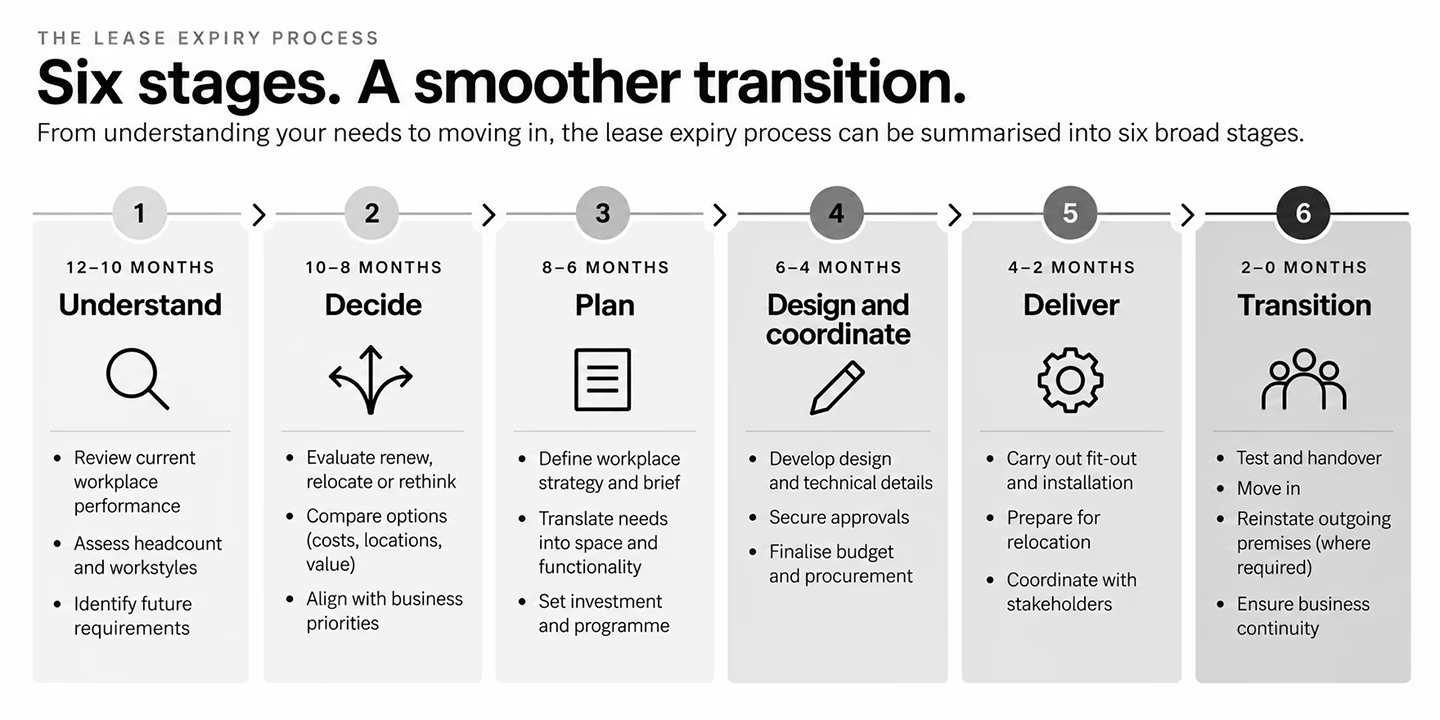
A 12-Month Office Lease Expiry Timeline
A 12-month planning window can be divided into several stages, with each stage answering a different workplace question.
The exact timing will vary according to project size, lease conditions, building requirements and organisational complexity.
The purpose of the timeline is therefore not to create a rigid formula.
It is to help businesses understand which decisions should happen before others.
12–10 Months: Understand
The first stage should not be choosing a new office.
It should be understanding the business.
Before deciding whether to renew or relocate, organisations need a clearer view of what the workplace should support over the next lease cycle.
Review today
Consider:
- What is working, underused or creating operational issues?
- Does the space support current workstyles and occupancy patterns?
- What employee feedback should be addressed?
Plan for tomorrow
Consider:
- Future headcount, growth and team structure
- Technology and client-facing requirements
- Work policies and longer-term business needs
Early space planning helps determine how much space is needed and what it needs to support, without planning solely around today’s requirements.

10–8 Months: Renew, Relocate or Rethink?
Once workplace requirements are clearer, the organisation can begin evaluating its main options.
Option 1: Renew
Lease renewal may make sense when:
- The location continues to support the business
- The available space remains suitable
- Relocation costs or disruption outweigh the benefits
Renewing does not necessarily mean leaving the workplace exactly as it is.
A lease renewal can also provide an opportunity for an office renovation, refresh or reconfiguration so the existing workplace better supports current ways of working.
Option 2: Relocate
Office relocation may be worth exploring when:
- The organisation has outgrown the current space
- Building infrastructure creates limitations
- A different property provides stronger strategic or commercial value
The workplace brief developed earlier can help evaluate potential sites based on more than rent or floor area.
A lower-cost property is not necessarily the stronger workplace decision if the space cannot support the organisation’s functional requirements.
Option 3: Rethink the footprint
There can also be a third path.
The organisation may remain in the same building but change the amount of space it occupies.
This could mean:
- Expanding into adjacent space
- Consolidating the existing footprint
- Reducing underused areas
The question one should ask then becomes
“Which workplace option best supports the business over the next lease cycle?”

8–6 Months: Turn Business Needs Into Workplace Strategy
Once the property direction is clearer, business needs can be translated into spatial requirements.
Headcount tells you how many people you have, but not how much space you need or how that space should perform.
Workplace requirements can also depend on:
- Meeting demand
- Collaboration requirements
- Client areas
- Amenities
- Storage
What should the workplace enable?
Instead of beginning with room quantities, consider the outcomes the workplace should support.
For example:
- More effective focus environments
- A stronger client experience
- Better hybrid meetings
- Greater flexibility as teams change
The workplace programme should respond to these objectives instead of simply replicating the existing office.
What should be retained?
Whether renewing or relocating, suitable furniture, joinery and movable assets may be retained or reused.
Identifying these early can help inform design, budget, procurement and logistics.
6–4 Months: Design, Budget and Coordinate
With the workplace brief and property direction defined, detailed planning can begin.
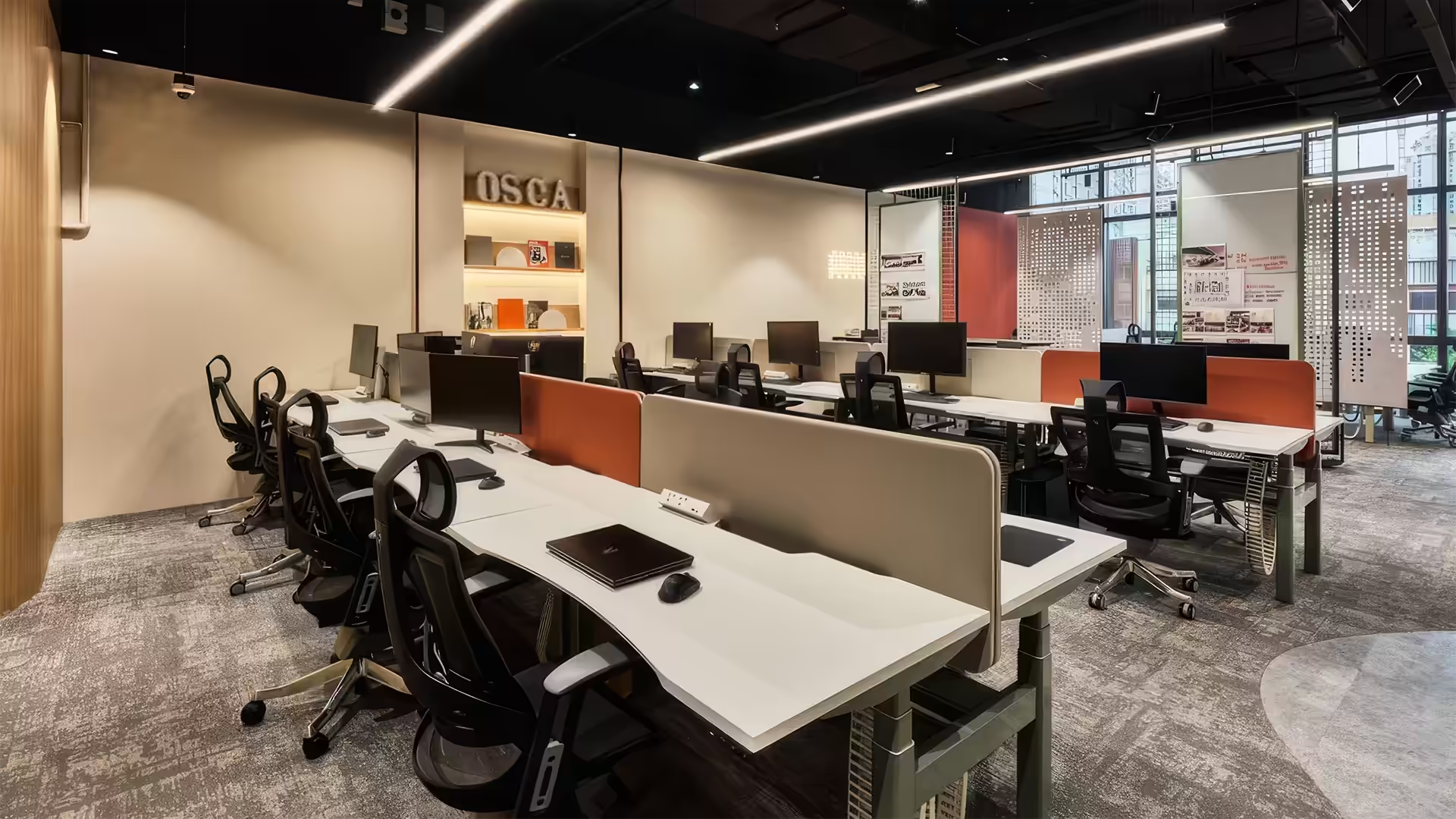
Design & Build brings together:
- Space planning and interior design
- Furniture, materials and finishes
- M&E, IT, AV and security
- Acoustics and technical coordination
- Cost planning and procurement
- Construction and Project Management
OSCA Asia coordinates these requirements from feasibility and design through construction and handover.
Plan approvals early
Landlord or other approvals may be required depending on the building and scope of work.
Identifying these requirements early helps avoid delays and keeps design, procurement and construction on schedule.

4–2 Months: Move From Planning Into Delivery
At this stage, planning moves into execution. The focus shifts to coordinating construction, procurement and business operations around the move.
Key priorities include:
- Construction and site coordination
- Furniture, equipment and technology installation
- Testing, inspections and handover
- Move planning and business continuity
Close coordination across the project team helps keep delivery on programme while minimising disruption to ongoing operations.
A Case Study by OSCA Asia
OSCA Asia’s ARK Group Global project at Odeon 333 in Singapore provides one example of coordinated delivery. The 8,130 sq ft new office was delivered over an eight-week project duration, and the client’s testimonial specifically highlighted the Project Manager’s coordination in keeping the project on schedule and within budget.
The point is not that every workplace can or should follow an eight-week programme.
It is that clear coordination between design, delivery, stakeholders and Project Management becomes increasingly important once a lease deadline is fixed.

2–0 Months: Transition and Prepare for Day One
As handover approaches, the focus shifts to ensuring the workplace, people and operations are ready for the move.
Key priorities include:
- Final inspections, testing and defect checks
- IT, AV and workplace systems readiness
- Furniture and equipment installation
- Move coordination and employee communication
- Operational handover and documentation
- Reinstatement of the outgoing premises, where required
The goal is a smooth transition with minimal disruption and a workplace ready for Day One.

Do Not Forget the Workplace You Are Leaving
For businesses relocating, planning the new workplace is only part of the process. The outgoing office may also require reinstatement before the lease ends.
Review requirements early, including:
- Lease and landlord reinstatement requirements
- Existing alterations, partitions and built-in elements
- M&E services that may need to be removed or restored
- Furniture and equipment to retain, relocate or dispose of
- Reinstatement costs and timeline
- Final inspections and handover requirements
Planning office reinstatement alongside the relocation helps avoid last-minute costs, delays and disruption.

A Simple 12-Month Office Lease Expiry Timeline
Common Lease-Expiry Planning Mistakes
- Waiting for the property decision before thinking about workplace needs Develop the workplace brief early.
- Assuming renewal means no workplace project Use lease renewal as an opportunity to review whether the workplace needs refreshing, reconfiguration or office renovation.
- Looking only at rent Evaluate the complete workplace decision rather than one cost line.
- Treating reinstatement as an end-of-lease task Review reinstatement requirements while evaluating relocation, not after the new office is already underway.
- Starting design before business requirements are clear Understand people, operations, space requirements and future business priorities before the design response is developed.
Common Questions About Office Lease Expiry in Singapore
When Should I Start Planning for an Office Lease Expiry?
For many organisations, around 12 months before expiry is a useful point to begin reviewing workplace requirements and comparing renewal and relocation options.
This does not mean every project takes twelve months.
Starting earlier simply provides more time before fixed deadlines begin reducing available options.
What Should Businesses Consider Before Renewing or Relocating?
Consider how well the current workplace supports the business, future space requirements, the cost and operational impact of each option, and whether the existing space can be adapted.
The decision should reflect both immediate needs and longer-term business plans.
How Long Does an Office Fit-Out Take?
It depends on project size, complexity, approvals, procurement and technical requirements.
OSCA Asia notes that smaller Design & Build projects may take around six to eight weeks, while larger and more complex projects may require several months.
The fit-out period should therefore be considered as one part of the wider lease-expiry programme rather than the entire timeline.
What Happens to My Existing Office If I Relocate?
The existing premises may need to be vacated and reinstated according to the lease requirements before being returned.
This can mean that office relocation and office reinstatement need to be managed at the same time.
Should Workplace Planning Happen Before Property Selection?
Ideally, the organisation should understand its workplace requirements before committing to a property decision.
Early workplace planning and space planning can help determine:
- How much space is actually required
- What types of settings are needed
- Which existing assets can be reused
- Which potential sites can support the intended workplace
What Happens If Lease-Expiry Planning Starts Too Late?
Office relocation planning should cover the new workplace, move logistics, technology and operational continuity, as well as reinstatement of the outgoing office where required.
Starting early helps coordinate these activities around the lease expiry and minimise disruption to the business.
Where Does OSCA Asia Fit Into the Lease-Expiry Journey?
Lease expiry brings together property decisions, workplace planning, design, project delivery and operational timing.
Managing these areas separately can create gaps between decisions.
At OSCA Asia, the workplace conversation can begin before design.
Through feasibility and workplace planning, businesses can first understand their requirements, site constraints and opportunities before deciding how the workplace should be designed and delivered.
From there, OSCA Asia’s services can connect Design Consultancy, Design & Build and Project Management within the wider workplace journey. OSCA Asia describes its Design & Build process as moving from feasibility and site assessment through design, coordination, Project Management and final handover.
For businesses approaching lease expiry, this helps connect three questions that should not be considered separately:
- Where should we be?
- What should our workplace do for the business?
- How do we deliver it within the time available?

Your Lease Expiry Is a Deadline. Your Workplace Decision Should Not Be.
Starting early gives businesses more time to understand their workplace needs, compare options, and plan around the lease timeline.
Whether the next step is to renew, relocate, or rethink the existing workplace, the goal is to make a business-led decision rather than a deadline-led one.

Planning for an Upcoming Office Lease Expiry?
OSCA Asia can help you assess your workplace requirements and plan the right next step.