An office relocation is not simply a moving-day exercise.
Planning an office relocation in Singapore involves much more than booking movers and deciding which Friday evening to shift the boxes. The real work is coordinating the new workplace, IT, furniture, employees and the handover of the existing office so that they reach the right stage at the right time.
For many businesses, these workstreams overlap. The new office may still be going through fit-out while furniture is being delivered. IT teams may need early access before employees arrive. Meanwhile, the existing office must remain operational until the move and may then need to undergo reinstatement before it can be handed back to the landlord.
That is why a relocation plan should be built around two outcomes: when the new workplace needs to be operational and when the existing premises need to be returned.
This guide provides a practical relocation timeline and checklist for businesses in Singapore, with a focus on workplace planning, fit-out, IT, furniture, employee communication, reinstatement and business continuity rather than purely logistics.
What Should an Office Relocation Plan Cover?
Before building a task list, confirm the dates that cannot easily move.
The first is the target First Day in the new office.
The second is the final date for returning the existing premises to the landlord.
Between these dates sit several separate but connected activities:
- New office design, fit-out or renovation
- Furniture delivery and installation
- IT and AV setup
- Employee communication
- Packing and asset transfer
- Physical relocation
- Office reinstatement
- Landlord inspection and handover
A relocation plan becomes difficult when these activities are treated independently.
For example, the fit-out contractor may consider the new workplace substantially complete while IT still needs several days for configuration and testing. The moving contractor may have a confirmed date while the building’s service lift has not yet been booked. Or the old office may need to remain operational longer than expected, reducing the available reinstatement period.
The project programme should clearly outline these factors from the start.
If the new premises require substantial construction, that workplace programme should also be planned separately from the move itself. OSCA Asia’s Design & Build process, for example, begins with feasibility and site assessment before moving through design development, coordination, project management and handover.
An Example 12-Week Office Relocation Timeline
The following 12-week timeline is a planning example, not a standard duration for every office relocation in Singapore.
A relatively straightforward move into an already completed office will require less coordination. A larger relocation involving new fit-out, approvals, long-lead furniture or complex IT may need to start much earlier.
The useful way to read this timeline is therefore:
12 weeks before operational move-in, what should already be happening?
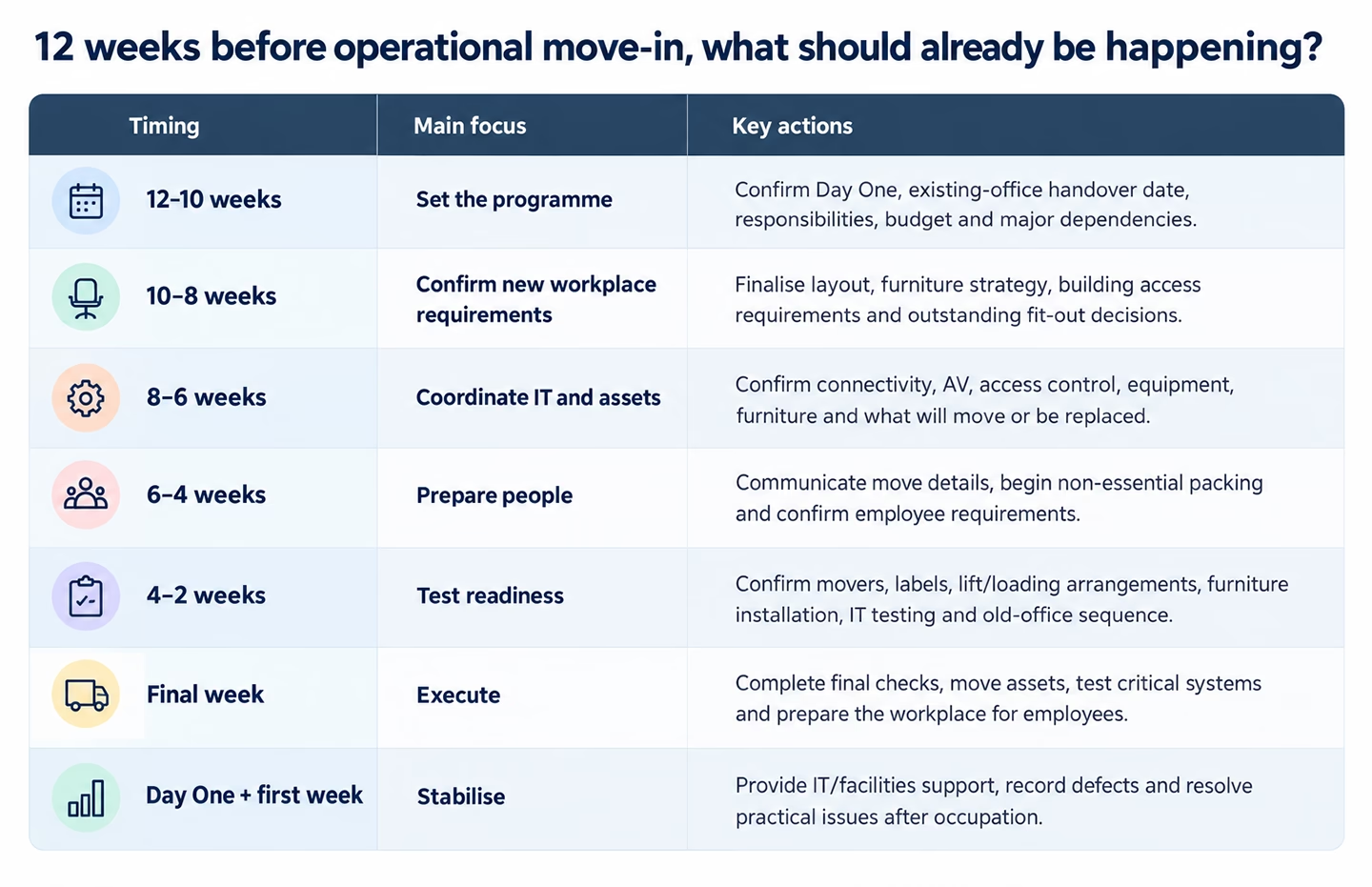
The important distinction here is between the relocation timeline and the design/construction timeline.
If your new premises require an office renovation or full fit-out, those works can extend beyond this 12-week move-coordination window depending on project size and complexity. OSCA Asia’s existing office renovation guidance similarly treats programme duration as dependent on scope and project complexity rather than one fixed timetable.
Who Should Be Responsible for What?
One practical problem in relocation projects is that everyone knows what needs to happen, but ownership is unclear.
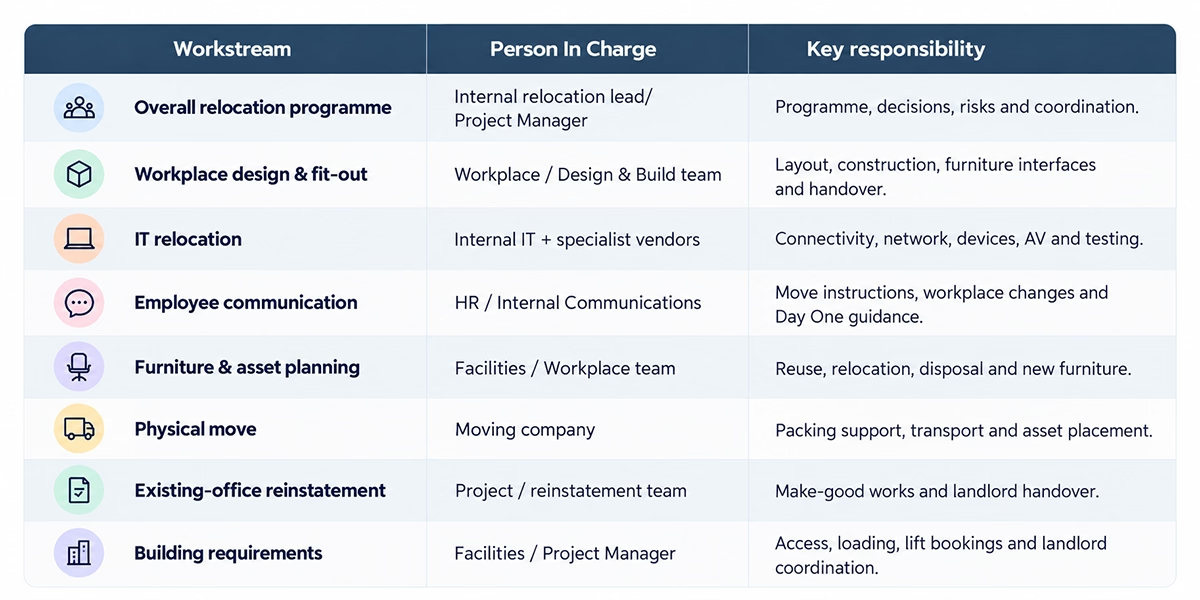
The exact ownership will vary by organisation.
What matters is that each task has one accountable person.
This is also where Project Management can add value on larger relocations. OSCA Asia’s Project Management service is structured around coordinating programme, resources, contractors and project stakeholders from planning through handover.
Make Sure the New Office Is Actually Ready
A workplace can look finished in photographs and still not be ready for employees.
Before setting the final move date, check the items that affect daily operations.
Workplace and fit-out
Confirm that essential areas are complete and usable, including:
- Workstations
- Meeting rooms
- Reception
- Pantry
- Storage
- Focus or collaboration spaces
- Signage
- Required furniture
Outstanding defects should be reviewed according to their impact.
A small cosmetic defect may not prevent occupation. A meeting room without working power or an incomplete access-control system might.
Where proposed alterations affect fire-safety systems or escape routes, check the Singapore Civil Defence Force’s plan-approval guidance early; any submission requirements depend on the nature of the works.
Building access
Requirements differ between buildings, so they should be checked directly with the landlord or building-management team.
Confirm matters such as service-lift access, loading arrangements, contractor registration, protection requirements and permitted moving periods early enough to affect the programme.
Do not assume the procedures at the existing building will be the same at the new one.
Employee access
Before Day One, confirm:
- Access cards
- Visitor procedures
- Reception arrangements
- Emergency information
- Employee arrival instructions
This may sound basic, but these are the details employees experience immediately.
Plan IT, Furniture and Packing as Separate Workstreams
The physical move is visible.
The IT move is often less visible until something fails.
Internet connectivity, Wi-Fi, meeting-room AV, printers, access control and employee systems should therefore have their own migration plan rather than appearing as one line in the general moving checklist.
IT relocation
Before employees arrive, the IT team should know:
- Which services can be installed in advance
- Which systems must remain operational in the existing office until the final working day
- What needs to move physically
- What needs configuration rather than relocation
- When testing can start
- Who responds if a critical system fails on Day One
Testing should reflect real use.
For a meeting room, that means more than confirming that the screen switches on. Test video calls, microphones, cameras, content sharing and network connectivity.
Furniture and equipment
Do not automatically move everything because it already belongs to the company.
Review each major asset against the new space plan.
Some existing desks, chairs or loose furniture may still work well. Others may not fit the dimensions, layout or working model of the new workplace.
The decision should be made before mover volume and packing requirements are finalised.
Office relocation packing
Packing should also be staged.
Archive material and low-use items can usually be prepared earlier, while equipment needed for daily operations may remain in place until close to the move.
Use a simple labelling convention that identifies at least the destination area and department or user. The objective is to reduce decisions at the receiving end.
Plan for the Existing Office Simultaneously
A relocation involves two workplaces.
The new office gets more attention because that is where the business is going. The old office still has to be closed properly.
Depending on the tenancy agreement, the outgoing premises may require office reinstatement before landlord handover.
The scope can vary considerably. It may involve removing tenant-installed partitions, furniture, signage or cabling, making good finishes, addressing building services and completing a final inspection.
The lease and landlord requirements should determine the scope.
Do not wait until after moving day to find out what needs to be reinstated.
OSCA Asia’s current reinstatement guide explains why floor area alone does not determine reinstatement requirements or cost; the lease, existing fit-out and required handover condition all matter.
A practical sequence might look like this:
Last working day in old office → physical move → operational launch in new office → clear remaining assets → complete reinstatement → landlord inspection → final handover
The exact sequence depends on the business and lease.
The important point is to protect enough time between moving out and handing the premises back.
Protect Business Continuity Around Move-In
The objective of an office relocation is not to move every item as quickly as possible.
It is to move the business without creating avoidable operational problems.
Start by identifying what the organisation cannot afford to lose access to.
That may include:
- Core network access
- Client communication channels
- Specific equipment
- Secure files
- Customer-facing teams
- Critical meeting facilities
Then plan the move around those priorities.
For contingency planning, Singapore’s IMDA guidance on digital connectivity disruptions highlights backup connections and offline business-continuity arrangements.
Where practical, some activities can happen before the main move:
- Install new furniture
- Activate connectivity
- Configure rooms
- Test access control
- Move non-essential items
- Set up reception and shared facilities
The physical move can then focus on the assets and systems that actually need to transition from one site to the other.
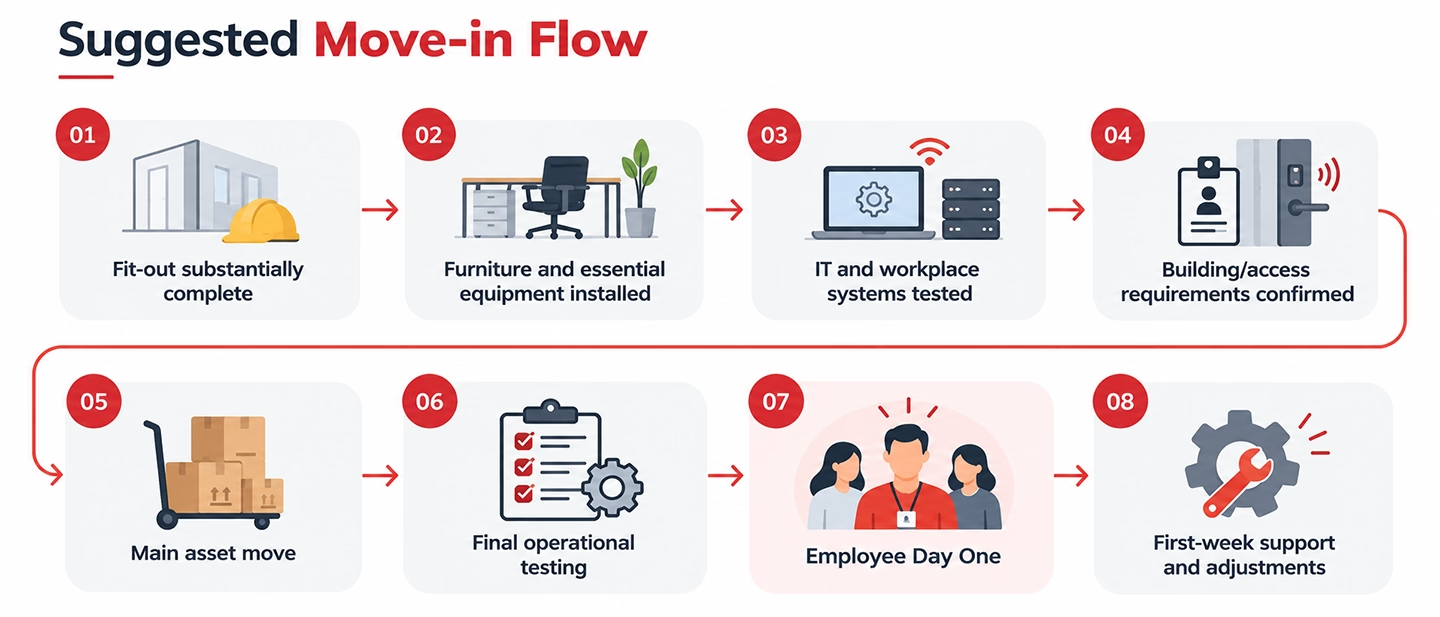
This flow is intentionally simple.
Its purpose is to stop “construction complete” and “ready for employees” from being treated as the same milestone.
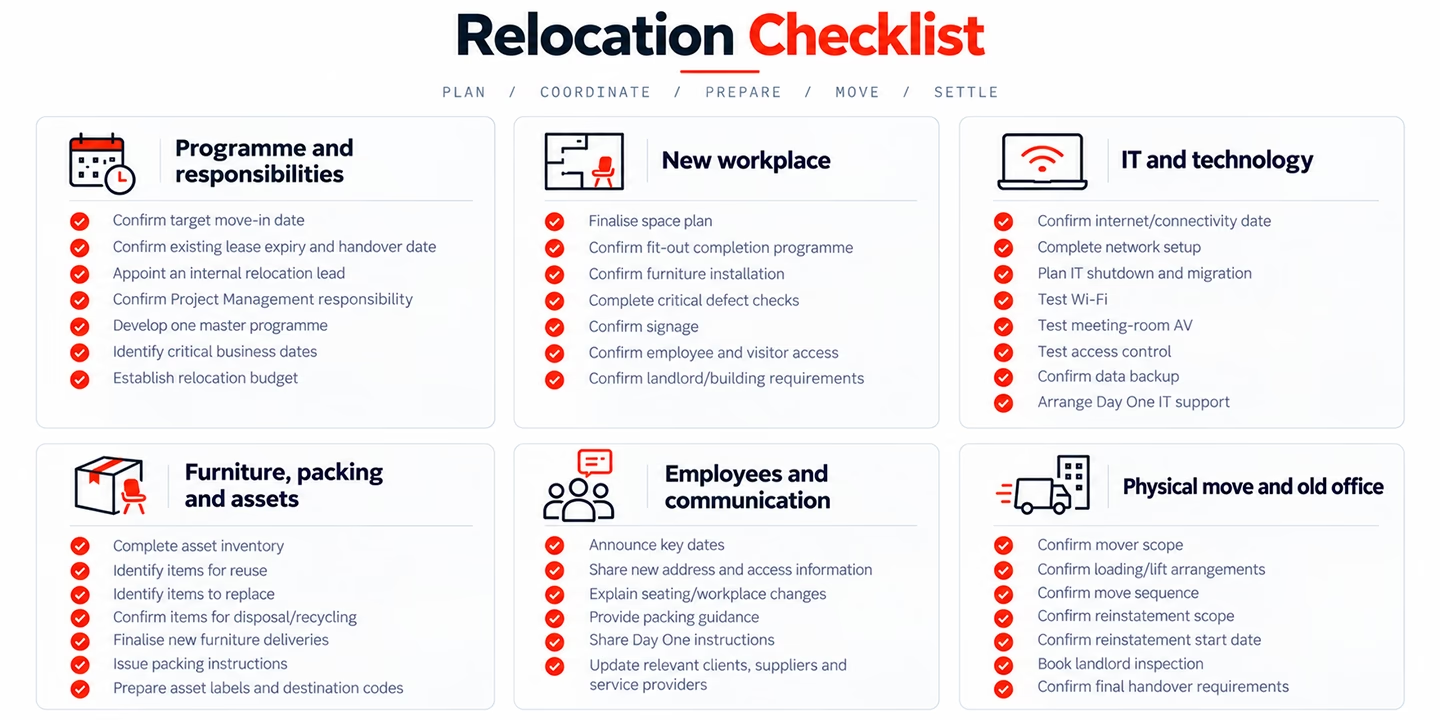
Office Relocation Checklist
A Real Relocation Example From OSCA Asia
In a client testimonial dated August 2020, China Telecom described relocating from Raffles City Office Tower to One Marina Boulevard as part of an expansion. OSCA Asia was involved in both the new-office interior fit-out and the reinstatement of the previous office. The client also noted that the project was completed in line with its budget, scope and schedule.
What makes this example relevant is not the size or style of the workplace.
It shows why relocation should be viewed as a connected programme.
The incoming workplace and outgoing workplace both require attention, and the transition between them has to be coordinated around one business deadline.
Common Office Relocation Questions
How long should an office relocation take?
There is no universal duration.
The 12-week framework in this article is intended as an example for coordinating the operational move once the relocation direction and new workplace are sufficiently defined.
If the new premises still require substantial design, renovation or fit-out, that programme may need to start earlier.
Should an office move happen over a weekend?
It can be useful where business operations and building access allow it, but it should not be treated as a rule.
The right moving window depends on operational requirements, IT sequencing, landlord or building-management requirements and the availability of the relevant teams.
Who should lead an office relocation?
There should be one accountable internal owner.
Depending on project complexity, that person may work with an external Project Manager who coordinates workplace delivery, contractors, programme and handover while internal teams retain responsibility for business and operational decisions.
When should reinstatement be planned?
As soon as the business understands that it will leave the existing premises.
The reinstatement scope comes from the lease and landlord requirements, so reviewing these early gives the team more time to coordinate the old-office handover with the new-office move.
Should existing furniture be reused?
Where it remains suitable, yes.
The decision should consider condition, dimensions, ergonomics, fit with the new layout and the cost of dismantling, transporting and reinstalling it.
Planning Your Office Relocation With OSCA Asia
An office relocation sits between workplace planning and project delivery.
The new office must support the way the organisation works. Furniture and technology have to arrive at the right stage. Employees have to be prepared. The existing office still needs to be closed and handed back.
OSCA Asia’s workplace solutions bring together Design & Build and Project Management, allowing these decisions to be considered as part of one workplace programme rather than a collection of unrelated tasks.
For businesses planning an office relocation in Singapore, the starting point is therefore not the moving truck.
It is the programme that connects the old workplace, the new workplace and the business operating between them.
Planning an Office Relocation in Singapore?
If your business is preparing to move, OSCA Asia can help review the new workplace requirements, coordinate design and fit-out, manage the delivery programme and plan the transition towards Day One.