When an office lease in Singapore is approaching expiry, the first decision is not necessarily what the next office should look like. It is whether the business should stay where it is, improve the workplace it already has, or move somewhere else. If you are deciding whether to renew or relocate your office in Singapore, start by distinguishing property limitations from workplace requirements.
Some organisations reach lease expiry and discover that very little needs to change. Others still like the building but have outgrown the way their office is planned. In other cases, the limitation is not the workplace design at all: it is the location, building infrastructure or available floor space.
That is why the decision is rarely as simple as “stay or move”.
A more useful way to frame the choice is to separate three questions:
Does the property still work?
Does the workplace still work?
Will both continue to support the business through the next lease term?
Those answers can help narrow the decision towards three practical directions: renew the existing lease, renew and renovate or reconfigure the workplace, or relocate to a new office.
This article focuses specifically on how to compare those options. For the timing and step-by-step process leading up to lease expiry, our Office Lease Expiry Planning in Singapore: A 12-Month Workplace Timeline guide covers the planning journey in more detail.
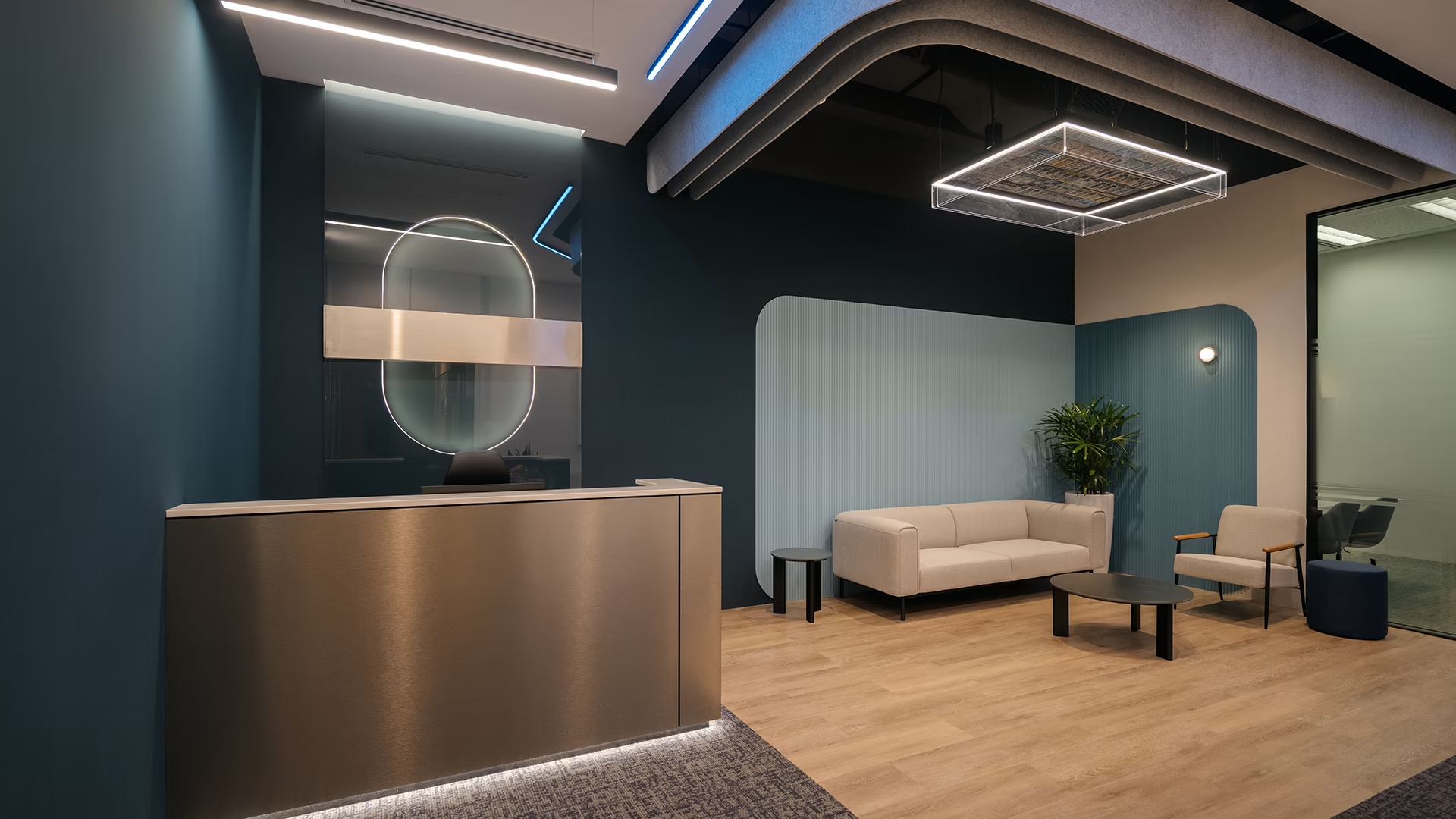
Renew or Relocate Your Office in Singapore: Where Does Renovation Fit?
Lease expiry can create the impression that a business has three completely separate choices. In practice, the relationship between them is more nuanced.
Renew
Renewing means staying in existing premises for another lease term.
If the current property and workplace still support the organisation well, renewal may require relatively little physical change. There may still be maintenance, furniture replacement or smaller improvements, but the basic workplace remains appropriate.
The important point is that renewal should be a deliberate choice rather than simply the path requiring the least immediate effort.
Renew and renovate or reconfigure
Sometimes the building still works but the workplace configuration does not. The organisation may value the location, available space or building amenities while finding that the internal environment no longer reflects how teams work.
In this case, lease renewal can become the trigger for an office renovation or reconfiguration, depending on the level of change required. The key question is whether improving the existing workplace can solve the problem without requiring a move.
Relocate
Relocation becomes relevant when the limitation sits beyond the interior.
Perhaps the business needs substantially more or less space. Perhaps the building cannot support future technical requirements. The location may no longer work for employees or clients. Or another property may provide a better fit for the organisation’s longer-term requirements.
In that situation, redesigning the current office may improve the workplace without solving the underlying property problem.
Relocation creates an opportunity to select a new property and develop the next workplace around a different set of requirements. It also brings a different investment and transition profile, including a new office fit-out, technology, furniture, moving requirements and potentially reinstatement of the outgoing premises.
How Do the Three Options Compare?
The most useful comparison is not “stay versus move”. It is how each option performs against the business criteria that actually matter.
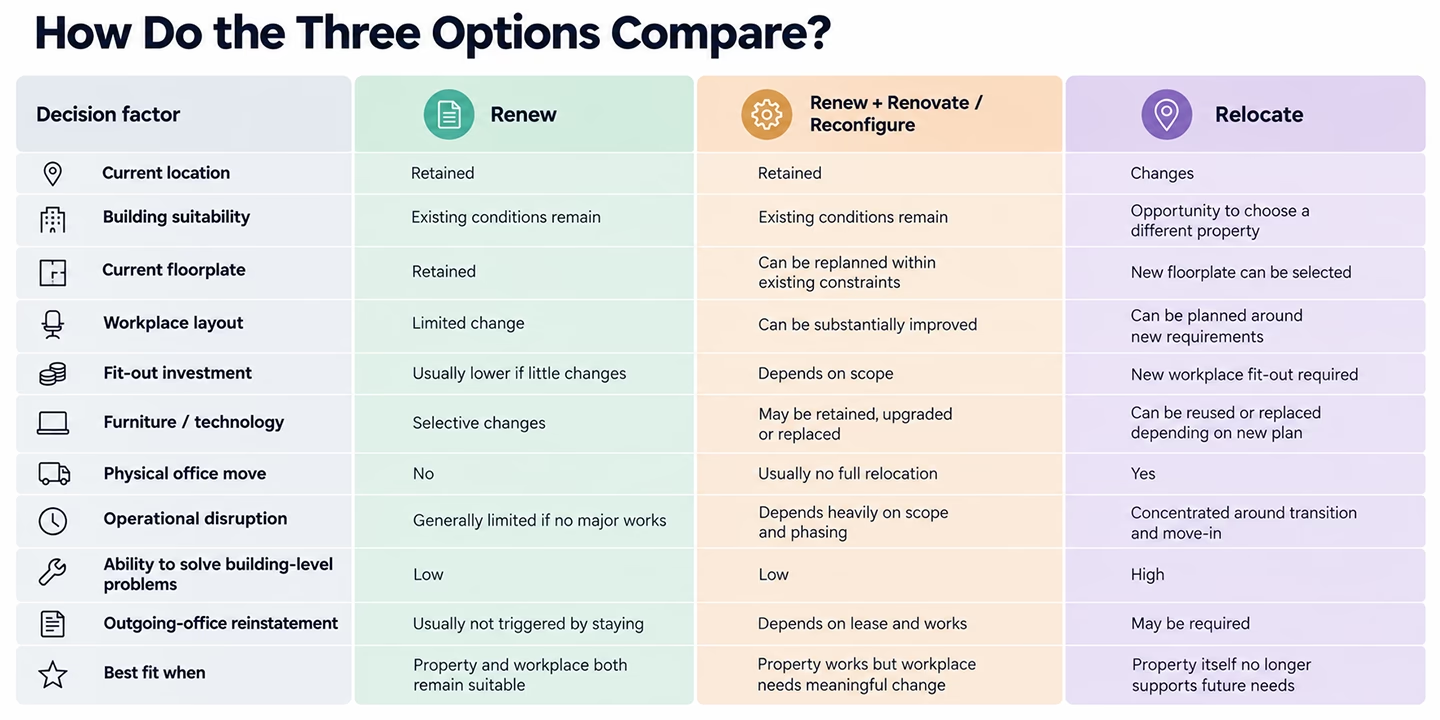
The comparison is qualitative because cost and disruption depend on the actual site, lease, project scope and business requirements.
A major renovation in an occupied workplace can sometimes require more operational coordination than relocating into a completed new office. Conversely, relocation is not automatically the more expensive option simply because a move is involved.
The purpose of the comparison is to identify which options remain genuinely viable before detailed planning begins.
Is the Problem the Building or the Workplace?
A useful way to separate a property problem from a workplace problem is to ask: If the office interior were redesigned properly, would we still want to leave this building?
If the answer is yes, the problem is probably larger than workplace design.
Building-level considerations may include:
- Location and accessibility
- Amount of available space
- Floor plan or floor area limitations
- Expansion capacity
- Base-building infrastructure
- Client requirements
- Building amenities
- Other operational constraints that the interior design cannot resolve
If the answer is no, relocation may be premature.
When evaluating a different property use, check the Urban Redevelopment Authority’s guidance on change-of-use approval before committing to a new tenancy or renovation.
The organisation may be dealing with a workplace problem rather than a property problem.
Workplace fit
Next, look at whether the current space is being used effectively before concluding that the business needs a different amount of floor area.
Businesses often approach lease expiry with one of two impressions:
“We need more space.”
or:
“We have too much space.”
Both may be true, but both should be tested.
A workplace can feel overcrowded because employees lack the right settings rather than because the overall floor area is insufficient. Meeting rooms may be concentrated in the wrong sizes. Large areas may be underused. Storage may occupy space that no longer creates much operational value.
The reverse can also happen. An office can have many empty desks and still perform poorly because employees struggle to find quiet rooms, collaboration settings or appropriate meeting spaces.
This is where space planning and workplace utilisation become useful.
If the current floor plan and overall floor area are fundamentally suitable, reconfiguration may solve problems that initially appear to justify relocation.
If the business cannot realistically accommodate its future requirements even after replanning, relocation becomes easier to justify.
Future fit
Finally, assess whether today’s solution will remain credible during the next lease term.
No organisation can predict its future perfectly. The purpose is not to forecast every change.
It is to identify the changes that are reasonably foreseeable:
- Headcount growth or reduction
- Team restructuring
- Changes in office attendance
- Different client-facing requirements
- Technology changes
- New meeting patterns
- More or less collaboration
- Different privacy or focus requirements
The strongest option is not simply the one that fixes today’s workplace problem. It should also provide enough flexibility for the business to evolve without immediately creating another space problem.
Compare the Full Financial Picture
Rent is highly visible.
Many other workplace costs are not.
That makes rent a poor standalone basis for comparing renewal, renovation and relocation.
Instead, compare the cost categories that apply to each realistic scenario.
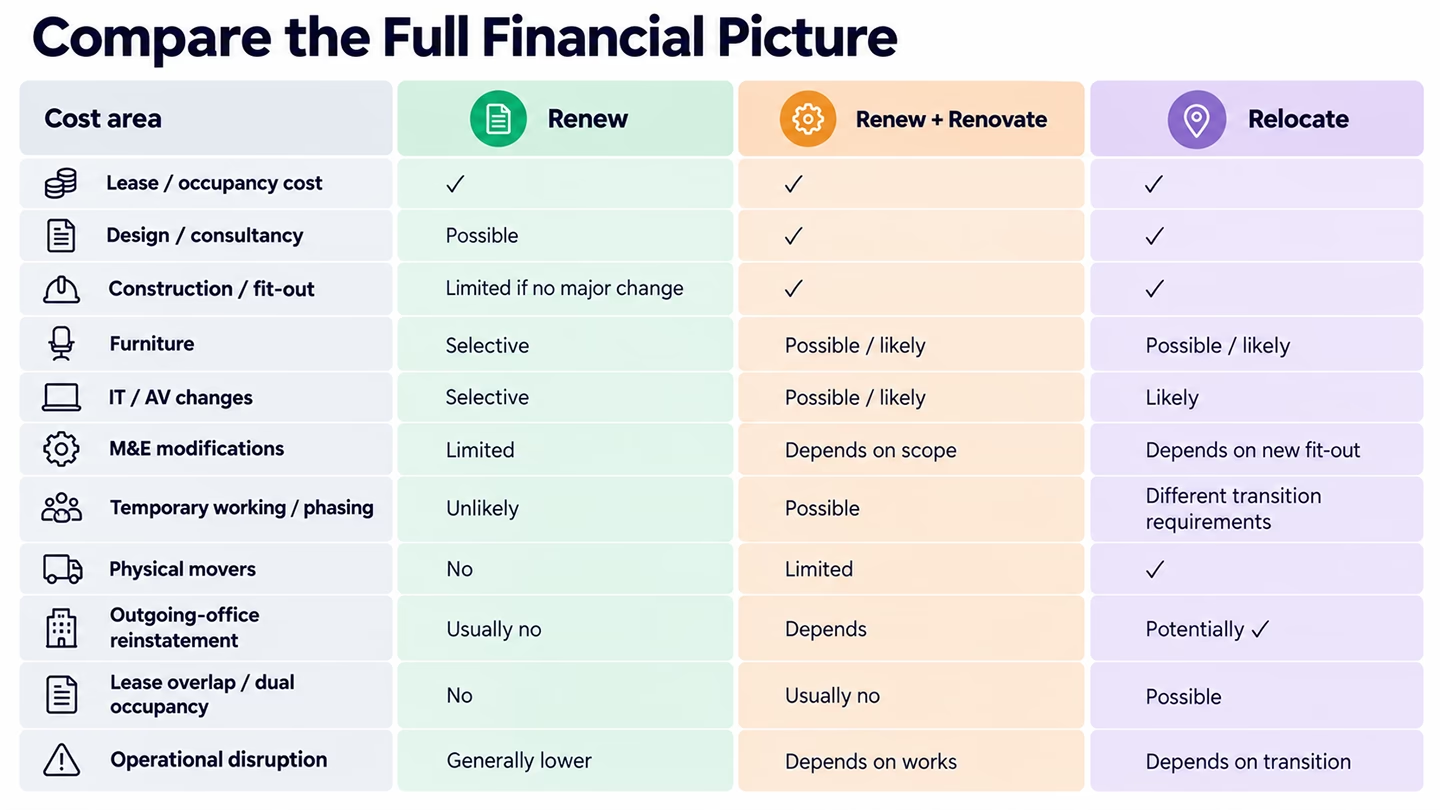
This is not a cost estimate. It is a prompt to make sure the business is comparing like with like.
A relocation may come with an attractive rental proposition but require investment in fit-out, IT, furniture, moving and the outgoing premises.
A renewal may avoid a physical move but still require substantial workplace investment if the current office no longer performs adequately.
Likewise, an extensive renovation should not be assumed to be the “middle-cost” option. Scope, existing conditions, M&E requirements and whether works take place in an occupied workplace can materially affect the project.
Our office renovation guide similarly recommends considering design, construction, M&E, furniture and IT as part of project budgeting rather than looking at construction cost alone.
The decision should therefore compare the cost of making each viable option work, not simply the headline rent or initial construction number.
Which Option Creates the Most Manageable Disruption?
Disruption matters, but it should be treated as a decision criterion rather than a separate relocation plan.
Renewing without major physical works generally creates the least immediate workplace disruption.
Renovating an occupied office can require phasing, temporary work areas or works outside normal operating hours depending on the scope.
Where proposed alterations affect fire protection systems or escape routes, the Singapore Civil Defence Force’s plan approval requirements should also be reviewed as part of the renovation assessment.
Relocating allows much of the new workplace construction to happen away from employees, but the business then has to manage a physical transition between two locations.
There is therefore no universally “least disruptive” option.
A better question is: which form of disruption can the business manage most effectively?
A client-facing organisation with critical on-site operations may view occupied renovation very differently from a company that can temporarily support more remote working.
Likewise, a business with specialist equipment or infrastructure may find physical relocation substantially more complex than an organisation using conventional office settings.
Once relocation has been selected, our Office Relocation Checklist & Timeline covers the move from workplace preparation through to Day One.
A Practical Renew-Renovate-Relocate Decision Framework
Rather than moving directly from lease expiry to property search or design concepts, work through the decision in a deliberate order.
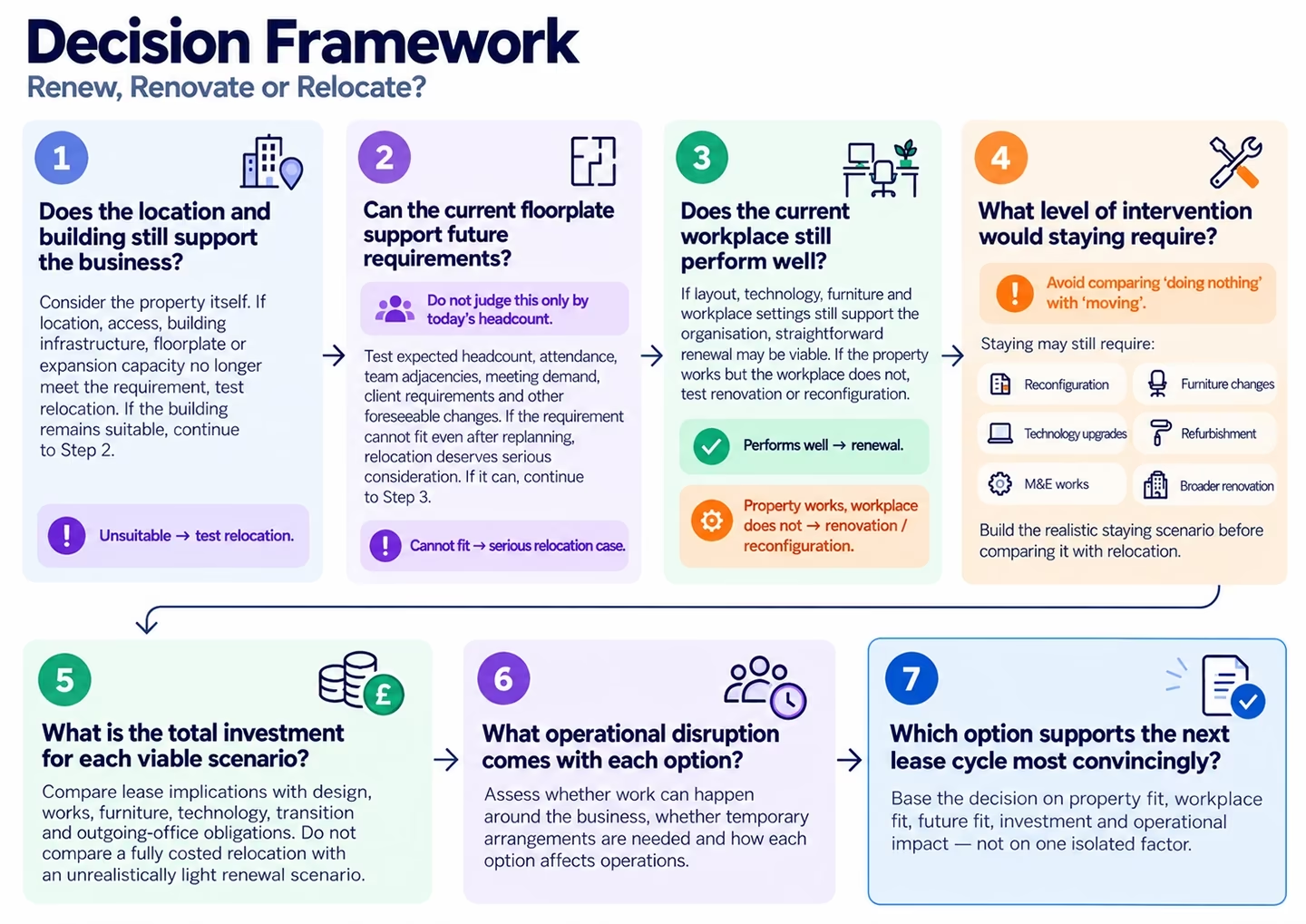
Once the direction is clear, the next step is to turn that decision into a workable timeline. Office Lease Expiry Planning in Singapore: A 12-Month Workplace Timeline covers that process from early workplace review through to fit-out, transition and handover.
When Renewal Makes Sense
Renewal is strongest when staying is a positive choice rather than the absence of a better idea.
It may make sense when:
- The location continues to support employees, clients and operations
- The building remains technically suitable
- The existing floor area and configuration can support foreseeable headcount and workplace requirements
- The workplace itself is still performing adequately
- Required improvements are relatively limited
- The commercial case for remaining is competitive with realistic alternatives
A business should be able to explain why the current premises deserve another lease term.
If the main reasoning is simply “moving would be difficult”, unresolved workplace or property issues may continue for several more years.
When Renovation or Reconfiguration Makes Sense
Renovation or reconfiguration becomes particularly relevant when the property passes the test but the workplace does not.
Common triggers can include:
- Poor space allocation
- Meeting-room shortages
- Too much or too little assigned seating
- New hybrid-working patterns
- Outdated technology
- Ageing furniture or finishes
- New organisational structures
- Changed client-facing requirements
Not every problem needs the same level of intervention. Our Office Reconfiguration Singapore guide explains how refresh, reconfiguration and optimisation can address different workplace issues, while a larger renovation may be more appropriate where more extensive infrastructure, finish or functional changes are required.
A useful test is whether improvements to the current workplace would remove the main reasons the organisation is considering leaving. If yes, staying and changing the space deserves comparison with relocation. If no, the business may be trying to renovate around a property problem that design cannot solve.
When Relocation Makes Sense
Relocation becomes more compelling when limitations extend beyond the interior workplace.
Examples can include:
- Insufficient or excessive floor area
- Limited expansion options
- A location that no longer supports the business
- Building infrastructure that cannot meet future requirements
- An office configuration that prevents viable space planning
- A strategic reason to move closer to employees, clients or other business functions
Relocation should therefore solve something meaningful that renewal or renovation cannot.
It also changes the cost comparison.
If the business relocates, the outgoing workplace may be subject to reinstatement or make-good obligations depending on the lease and landlord requirements. These costs should be considered alongside the new office fit-out, moving requirements and other transition costs. Our Office Reinstatement Cost in Singapore guide explains the key cost factors, typical scope and lease-handover considerations in more detail.
A Real Relocation Example From OSCA Asia
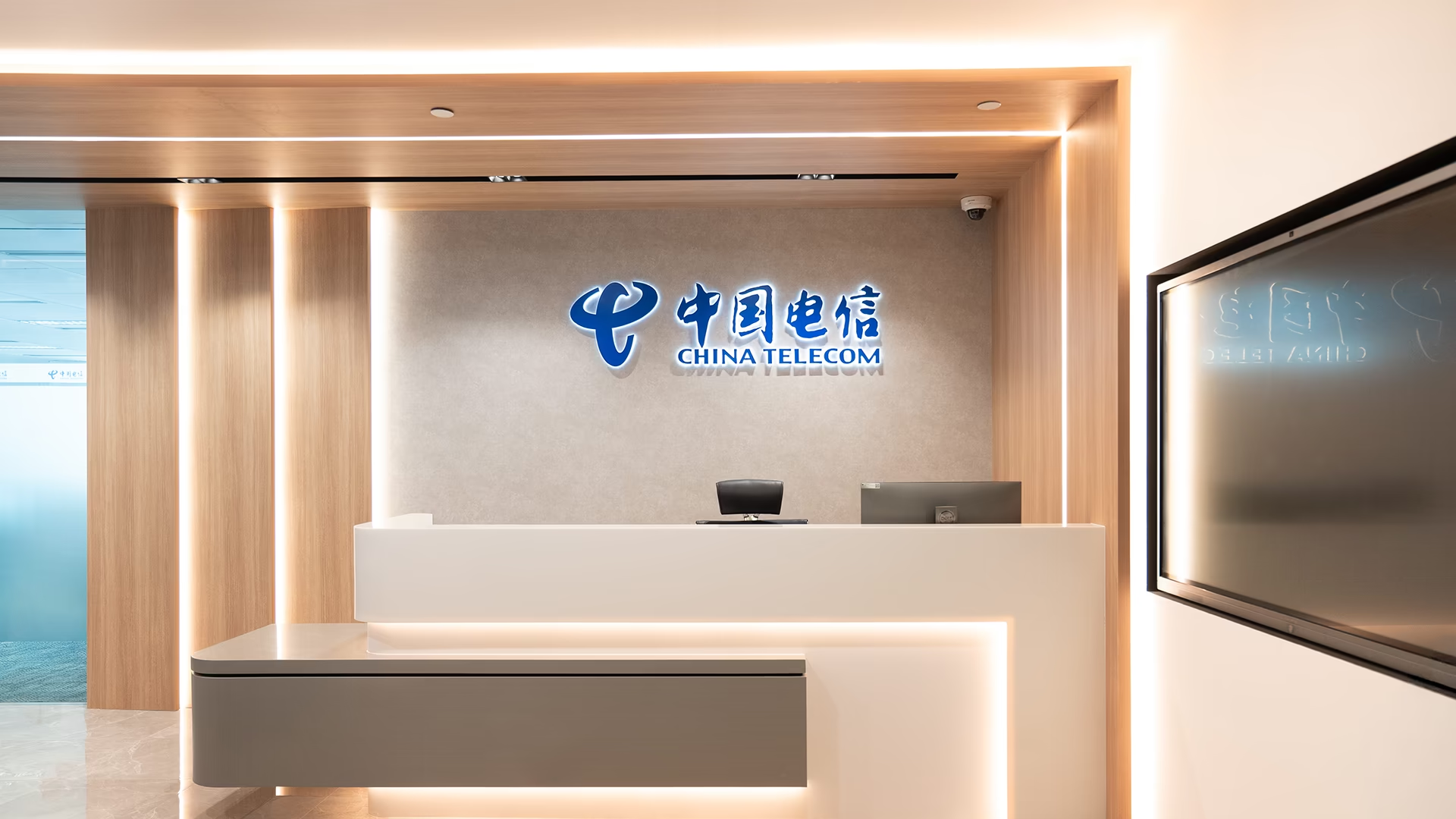
China Telecom (Asia Pacific)’s Singapore relocation provides a useful example of a situation where changing premises was linked to a clear business requirement: expansion.
According to a 2020 client testimonial, the company relocated from Raffles City Office Tower to One Marina Boulevard into premises approximately three times larger than its previous office.
OSCA Asia was involved in both the interior fit-out of the new workplace and reinstatement of the previous office. The client stated that the project was completed in accordance with its budget, scope and schedule.
The relevant point for this decision guide is not the design style or the moving process. It is the reason behind the property decision.
The existing premises no longer matched the company’s expansion requirements, so the solution needed to go beyond redesigning the existing workplace.
That distinction is exactly what businesses approaching lease expiry should establish before selecting an option.
Common Decision Questions
How do we know whether the problem is our workplace or our building?
Ask whether a well-planned redesign of the current office would remove the reasons you are considering leaving.
If the answer is largely yes, the problem may sit within the workplace and renovation or reconfiguration should be tested.
If location, infrastructure, space capacity or other property constraints would remain, relocation may offer a more complete solution.
Should we renew the lease if the office still works?
Potentially.
If both the property and workplace continue to support current and foreseeable business requirements, there may be little value in creating change for its own sake.
The decision should still take the next lease term into account rather than only today’s requirements.
Can renovation avoid the need to relocate?
It depends. There is no fixed answer.
Reconfiguration or renovation can address poor space allocation, outdated work settings, technology, finishes and some infrastructure requirements.
It cannot solve every property limitation.
That is why renovation should be tested against the reasons the business is considering relocation rather than treated as an automatic cheaper alternative.
Is renovation always cheaper than relocation?
No.
There is no reliable answer without comparing actual scopes.
An extensive renovation can involve design, construction, M&E, furniture, technology and operational phasing.
Relocation involves a different combination of new-office fit-out, transition costs and potentially reinstatement.
Cost should be compared scenario by scenario.
What if both renovation and relocation could work?
Then the decision becomes a comparative business case rather than a purely spatial one.
Evaluate the options against:
- Total investment
- Workplace performance
- Operational disruption
- Property suitability
- Future flexibility
- Commercial lease considerations
- The length of time the solution is expected to serve the business
If both remain viable after that comparison, commercial property and workplace considerations should be reviewed together before committing.
If you need to understand what should happen in the months leading up to expiry, read our Office Lease Expiry Planning in Singapore: A 12-Month Workplace Timeline.
Discuss Your Workplace Options With OSCA Asia
A lease expiry can lead to design and construction, but the first decision comes earlier: determining which workplace direction is actually appropriate.
That may mean staying where you are.
It may mean retaining the property and changing the workplace.
Or it may mean choosing a new site and designing the next office around different business requirements.
OSCA Asia can help review workplace requirements and site conditions before those decisions move into design and delivery. Once the direction is established, Design & Build can connect workplace planning, design development, technical coordination and delivery through to handover, while Project Management provides coordinated oversight of timelines, resources, contractors and project stakeholders.
You can also explore our workplace projects across Singapore to see how these approaches have been applied across new offices and workplace transformations.
Deciding Whether to Renew, Renovate or Relocate?
Before committing to another lease term or starting a property search, establish what is driving the decision.
OSCA Asia can help assess your existing workplace, identify the requirements for the next lease cycle and explore whether renewal, renovation or relocation provides the stronger workplace direction.