As organizations grow, the challenge is not only securing additional square footage but also ensuring that expansion strengthens workflow rather than fragments it. This is where contiguous office space becomes a strategic solution. In this article, OSCA Asia explains what contiguous office space is, outlines its measurable benefits, identifies when it is the right strategic choice, and provides a structured planning framework.
1. What Is Contiguous Office Space?
1.1 Definition about contiguous office space
Contiguous office space is a commercial leasing arrangement where a company occupies multiple adjoining floors or sections in one building, configured to function as a single operational unit.
In technical terms, “contiguous” means sharing a common boundary. In office planning, it means:
- Floors stacked vertically (e.g., Level 5 and Level 6)
- Sections positioned side-by-side on the same floor
- Areas linked by an internal staircase or dedicated lift access
The core principle is continuous spatial flow. Staff should move between departments without entering public zones.
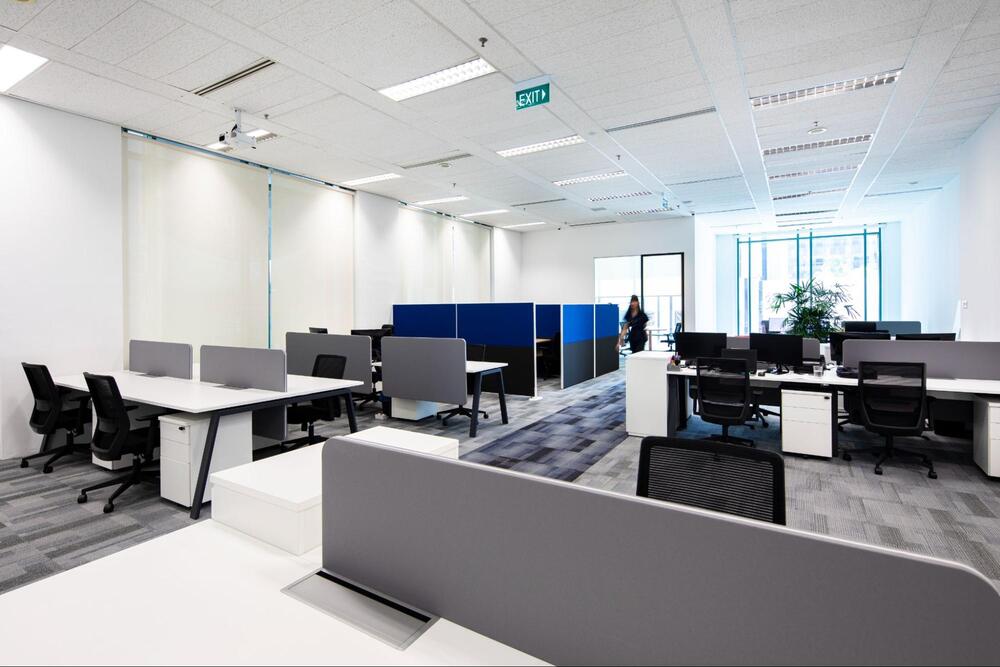
Side-by-side working sections within the same floor plan
1.2 Key benefits of contiguous office space
Contiguous office space delivers measurable operational and financial advantages when compared with fragmented office arrangements. Below are the core advantages of contiguous office space.
Operational integration
Contiguous office space allows multiple floors or sections to function as one unified workplace. Departments remain physically connected, which reduces internal barriers. Staff move between teams without exiting the secured premises. This improves coordination, shortens response time, and strengthens managerial oversight.
Improved workflow efficiency
When teams occupy adjacent floors, circulation becomes direct and predictable. Project groups can be vertically aligned to reduce travel time. Support departments can be placed between operational units to optimize workflow. This structure reduces duplication and supports faster decision-making.
Unified brand presence
A contiguous layout enables consistent brand expression across all occupied floors. Companies can implement one reception strategy, aligned design standards, and integrated signage. Clients experience a single professional environment rather than fragmented offices. This reinforces corporate identity and market positioning.
Simplified security and access control
Security management becomes more efficient within contiguous office space. Access points are consolidated. Visitor management is centralized. Vertical circulation, which refers to the movement of people between different floors or levels in a building, can be restricted through access card systems. This reduces operational risk and strengthens internal control.
Cost efficiency and reduced redundancy
Although rent per square foot may remain constant, overall occupancy costs can decrease. Companies avoid duplicate reception areas, repeated meeting rooms, and separate IT infrastructure. Fit-out investments are protected because expansion occurs within the same building. Relocation expenses and downtime are minimized.
Enhanced employee connectivity
A connected workplace reduces departmental isolation. Employees interact more easily across teams. Internal staircases can support movement and reduce lift congestion. Visibility between leadership and staff improves. This strengthens organizational cohesion.
Scalable growth without relocation
Contiguous office space supports phased expansion. Companies can secure adjacent floors as headcount increases. The business address remains unchanged, preserving client recognition and operational stability. This model provides structured growth while maintaining spatial continuity.
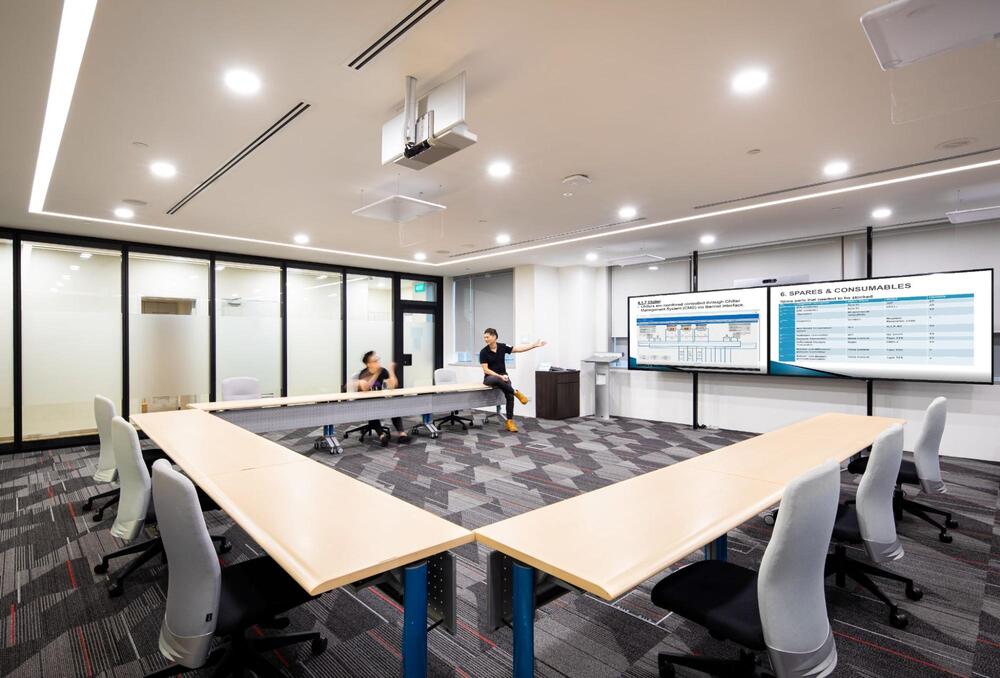
Centralized meeting room design in contiguous office space
1.3 When should a company choose contiguous office space?
A company should choose contiguous office space when operational growth demands expansion without strategic relocation. Consider this option under the following conditions:
- Headcount growth exceeds 80–90% of current capacity. If desks, meeting rooms, and support areas are near saturation, expansion is required.
- Inter-department collaboration is critical. Firms in finance, technology, consulting, and design rely on frequent coordination.
- Brand stability is important. Established firms benefit from maintaining the same business address.
- Fit-out investment has long-term value. If current design quality is high, vertical expansion protects that investment.
- Lease terms allow first refusal on adjacent floors. This secures growth without market competition.
Before proceeding, conduct this practical evaluation:
- Perform a workplace utilization study
- Forecast staffing for 3–5 years
- Calculate total occupancy cost across combined floors
- Review compliance with fire, disability access, and building codes
- Model circulation flow using test layouts
If the analysis confirms efficiency gains and manageable cost exposure, contiguous office space is a strategic solution.
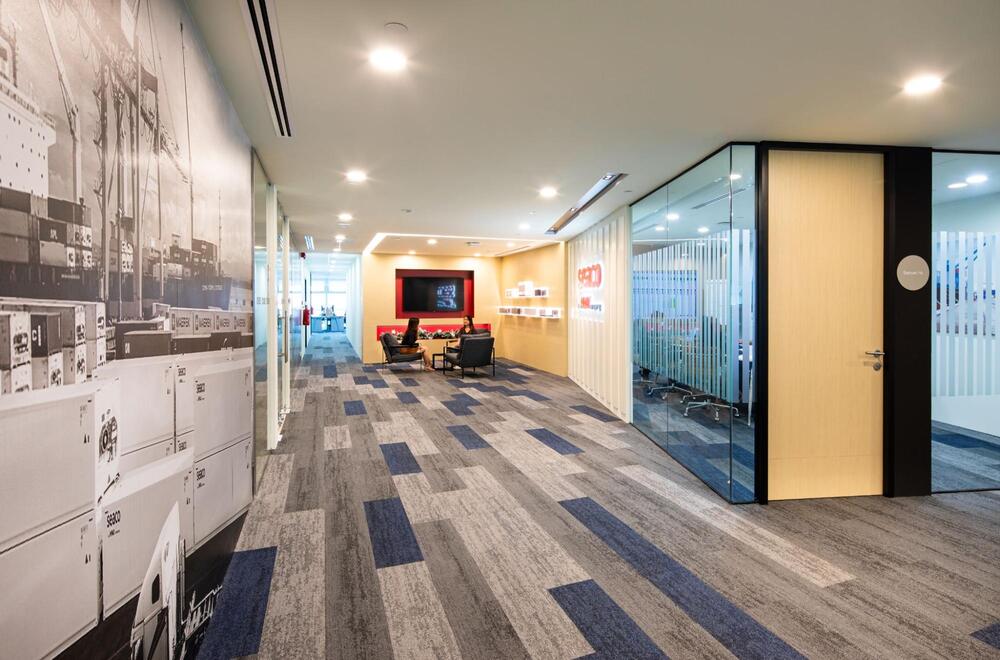
Workplace strategy assessment for contiguous office space
2. How to Plan a Contiguous Office Layout Effectively
2.1 Conduct Workplace Strategy Assessment
A workplace strategy assessment establishes spatial demand, operational logic, and risk exposure. Skipping this stage often leads to underutilized space or costly redesign.
Step 1: Analyze headcount and growth forecast
Prepare a three- to five-year staffing projection. Categorize employees by function, such as leadership, client-facing teams, technical departments, support services,…
Calculate required desk ratios. For example:
| Department | Staff Count | Desk Ratio | Required Workstations |
| Sales | 30 | 0.8 | 24 |
| Engineering | 40 | 1.0 | 40 |
| Admin | 15 | 0.9 | 14 |
Step 2: Map operational relationships
In a contiguous office space, vertical stacking should follow workflow logic. Identify which teams require direct adjacency. For example:
- Sales near meeting rooms
- Engineering near technical storage
- HR near management
Step 3: Conduct utilization analysis
Review:
- Meeting room occupancy rates
- Peak circulation periods
- Storage volume
- Equipment loads
Step 4: Confirm compliance obligations
Review fire regulations, disabled access standards, and maximum occupancy loads. Combined floors alter evacuation modeling. Consult fire strategy professionals if installing internal stairs.
Step 5: Define spatial objectives
Document clear targets:
- Target density (sq ft per person)
- Collaboration-to-focus space ratio
- Brand visibility requirements
- Visitor management strategy
This strategic framework ensures the contiguous office space supports both operational and financial goals.
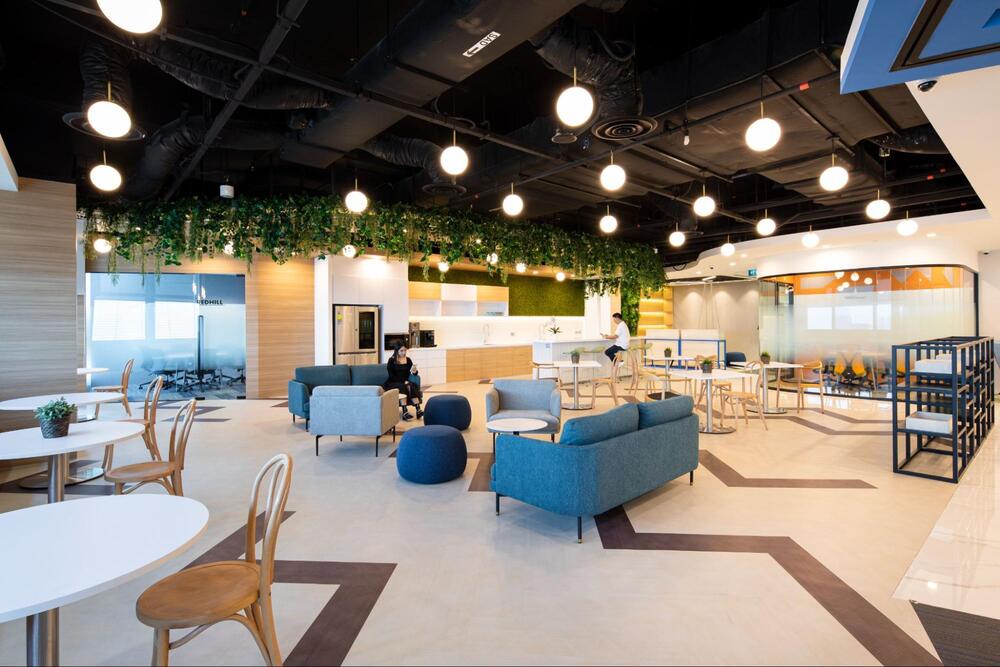
Headcount forecast and desk ratio planning
2.2 Space Zoning & Circulation Flow
Zoning defines how space is organized across floors. Circulation planning ensures movement remains efficient and compliant.
Step 1: Assign functional zones by floor
The structure supports privacy while preserving connectivity. A practical vertical zoning model may include:
| Floor | Primary Function |
| Lower floor | Reception and client-facing teams |
| Mid floor | Management and shared meeting rooms |
| Upper floor | Technical and focused work zones |
Step 2: Design clear circulation routes
Establish:
- Primary circulation spine
- Secondary internal connections
- Fire escape routes
- Controlled access areas
Movement between floors must be intuitive. Avoid forcing staff through client areas to reach operational zones.
Step 3: Evaluate internal staircase feasibility
Internal stairs strengthen physical connection within a contiguous office space. However, confirm:
- Structural capacity
- Fire compartmentation requirements
- Smoke control strategy
- Acoustic impact between floors
Step 4: Balance open and enclosed spaces
Allocate:
- Open workstations for collaborative teams
- Enclosed offices for leadership or confidential roles
- Phone booths for focused calls
- Formal and informal meeting areas
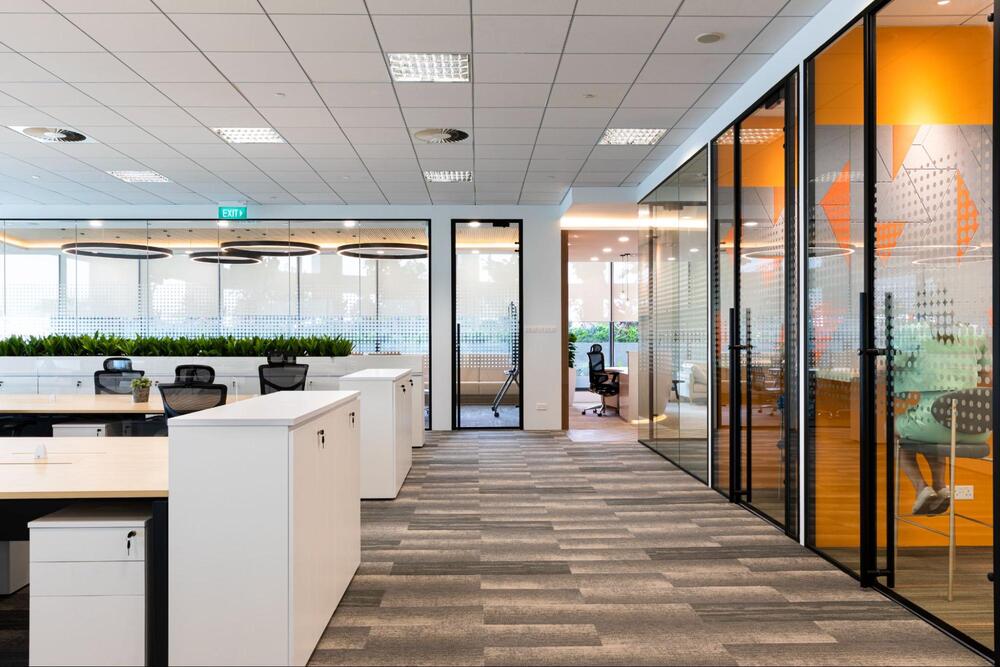
Space zoning for multi-level office layout
2.3 Acoustic & Privacy Planning
Step 1: Identify noise sources
Typical sources include open workstations, internal staircases, meeting rooms, mechanical systems,… In a vertical contiguous layout, sound transfer between floors must be considered.
Step 2: Apply zoning separation
Position quiet zones to reduce cross-floor disruption, away from:
- Reception areas
- Collaboration hubs
- Stair voids
Step 3: Specify acoustic materials
Select materials based on tested performance data. Install:
- Acoustic ceiling panels
- Carpet tiles with impact reduction backing
- Glazed partitions with acoustic ratings
- Solid-core doors for confidential rooms
Step 4: Protect confidential spaces
Finance, HR, and executive rooms require enhanced privacy. Confirm:
- Speech privacy standards
- Secure document storage
- Access control integration
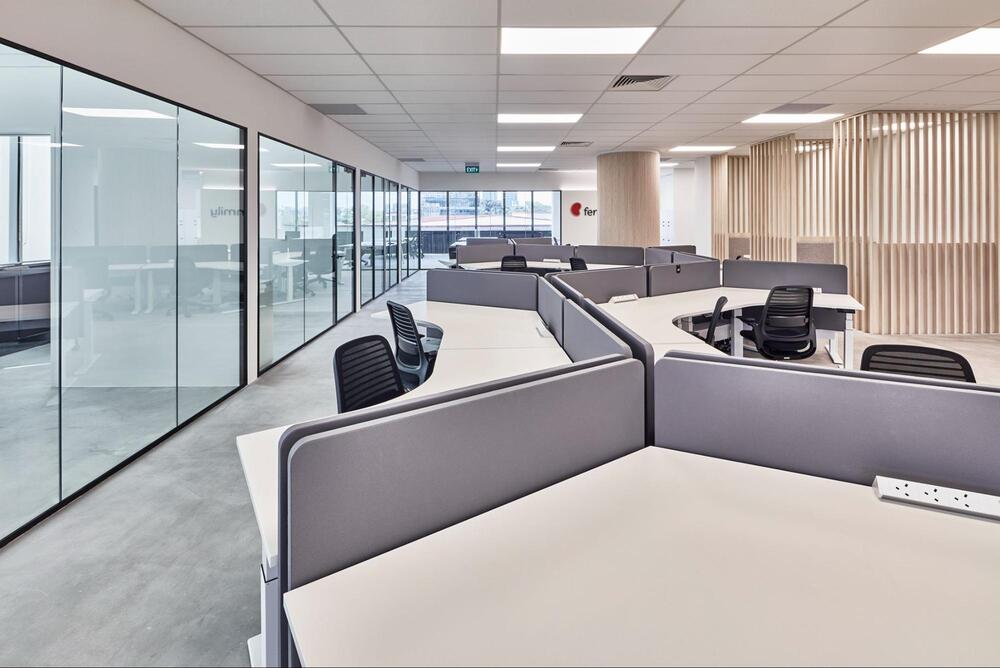
Modular partition systems in contiguous office space
2.4 Flexible & Modular Design
Step 1: Use modular partition systems
Demountable walls allow reconfiguration. This reduces future capital expenditure.
Step 2: Implement adaptable workstation systems
Choose desks that support:
- Height adjustment
- Reconfiguration
- Power and data flexibility
Step 3: Plan scalable infrastructure
Design:
- Raised floors for cable access
- Modular lighting grids
- Expandable HVAC zoning
This ensures new departments can be added without disruption.
Step 4: Reserve expansion capacity
Avoid allocating 100% of space at initial fit-out. Maintain contingency zones for future hires.
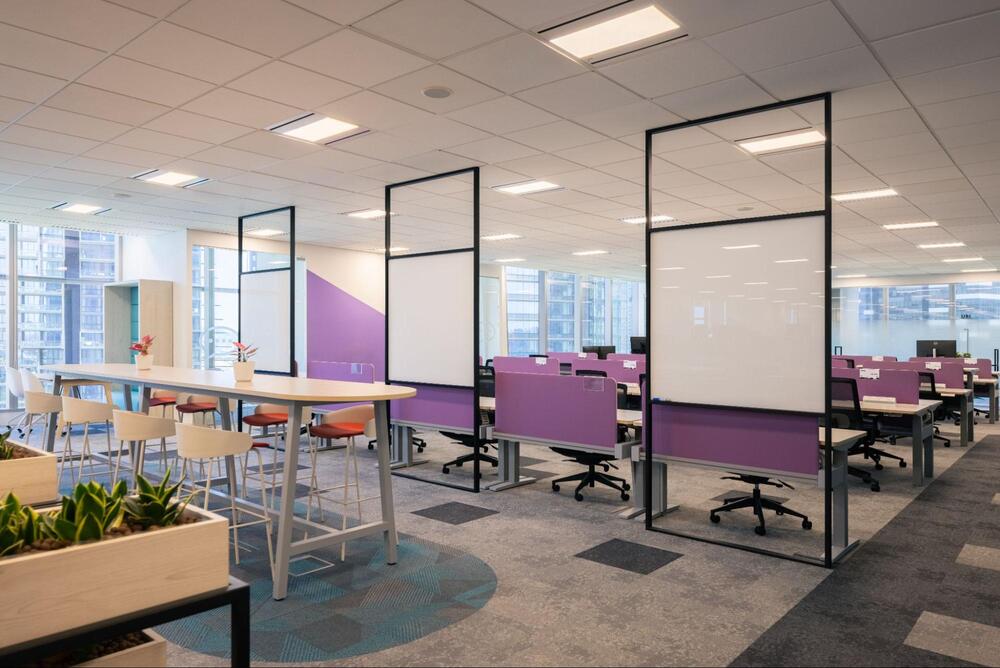
Flexible workstation layout for scalable growth
2.5 Sustainability & WELL Considerations
Sustainable planning reduces operational cost and improves staff wellbeing.
Step 1: Optimize natural light distribution
Place workstations near perimeter glazing. Position storage and service zones toward the core.
Step 2: Improve indoor air quality
Coordinate HVAC systems across floors to ensure balanced airflow. Monitor CO₂ levels.
Step 3: Select durable materials
Choose finishes with verified environmental certifications. Confirm lifecycle performance.
Step 4: Encourage movement
Internal staircases within a contiguous office space promote physical activity. Ensure compliance with safety standards.
Step 5: Monitor energy consumption
Integrate smart meters and zoning controls. Review performance quarterly.
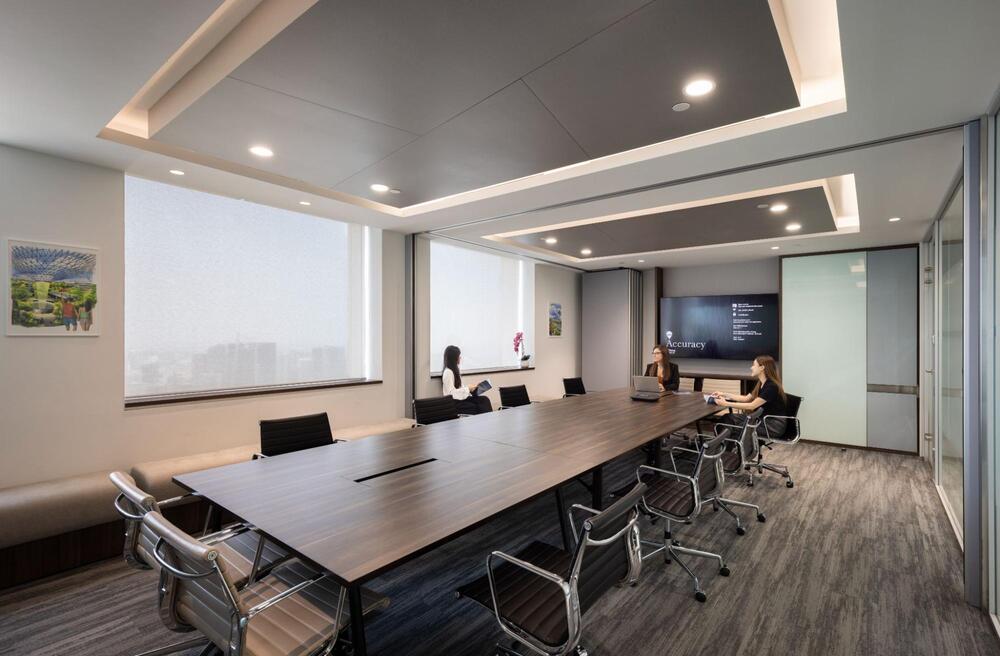
Natural light distribution in multi-floor office design
Contiguous office space provides a structured and controlled approach to business expansion. When adjacent floors are planned as a unified environment, organizations gain operational continuity, stronger brand presence, improved workflow efficiency, and long-term cost stability.
OSCA —Office Design & Build Specialist— delivers end-to-end services, including workplace consultancy, architectural planning, compliance coordination, fit-out construction, and project management.
By partnering with OSCA, businesses benefit from:
- Structured space planning aligned with growth forecasts
- Technical validation of fire safety and building systems
- Efficient circulation and zoning strategies
- Cost-controlled fit-out execution
- Sustainable and performance-driven design solutions
If your company is considering contiguous office space expansion, engage OSCA early in the process to secure a compliant, efficient, and future-ready workplace. A strategic design today protects operational performance tomorrow.
- Hotline: +65 6336 1800
- Email: sg@osca.asia